Windstone Farm Community


Reclaiming a Widely Forgotten Comradery
Settled in comfortably, a warm drink in hand, and an evening of being read to – this is a pleasure too many of us have not had since childhood, although once upon a time it was a regular adult activity. At Windstone Farm in rural Ontario, Canada, monthly ‘NovelNight by CandleLight’ evenings return us to this simple goodness, and have become one of our most popular community events. They are also our easiest to facilitate -- which has helped make them contagious: similar NovelNights now occur in cities around the world. We encourage you to consider hosting your own.
We begin by choosing the novel and date, and spreading the word – not for people to read in advance, but to build anticipation! NovelNight is not a bookclub – we are not
gathering to discuss a story. We are gathering to hear one.
No prep required – or even desired.
Although 21st century attention spans are degrading, they are still better than you might think. And reading a full (albeit short!) novel in one night is entirely possible. People
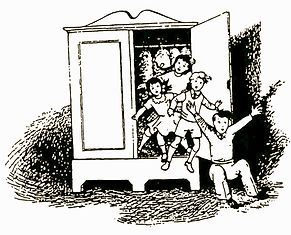
binge-watch Netflix for longer than a short novel takes to read. At Windstone we normally don’t exceed three and ½ hours (2 hours, quick intermission to refill plates, stretch legs, etc, then another 90 minutes) – but summertime ease does allow for longer stints: The Lion, the Witch, and the Wardrobe for example is just shy of 4 ½ hours and is a favourite evening read. We often split longer novels up into a part one and part two – with someone designated to give a summary of the first half on the night we read the second. Sometimes we have a series of related short stories. We’ve even intermingled poetry. We still call it “NovelNight.” ;)
We invite people to bring snacks to share, if they are able.
This means that all we have to prepare is the kettle and some teas, mugs on the counter ready-to-go. We light a few candles, and the fire, have a few blankets and pull up some cushions in case we run out of chairs. And we tidy the house – but do not over-tidy, because a house that is too tidy, too ‘perfect’, is not a space in which people can relax and feel comfortable. ‘Spotless’ is not homey, not welcoming…’too perfect’ is not actually hospitable: we do not want the house to be a showroom, let alone a space where people are on show – we want the house to be a home.
People are welcome to arrive a bit before the reading begins, because once we start reading there won’t be a lot of chat time. Yet despite limited milling about, the resulting cohesion of the group is always so striking. More on that in a bit.
Once everyone is settled, we welcome all and give a brief introduction to the author and the story. It can be fun to learn for whom the tale is an old friend, and for whom
a new adventure is about to begin. And we use the word ‘adventure’ advisedly, for that is what is about to happen: the people gathered in that room in your home
are about to embark on an adventure together.
People are invited to read a chapter (never more!), a page, a paragraph – or, not at all. And everyone is assured that it is ok if they fall asleep – who doesn’t love to fall asleep whilst being read to? – but that if they snore, they will be poked. We try, unobtrusively, to have the first two readers be strong readers – that helps pull listeners into the tale – and then after that, as the book is passed around the room, the reading levels may vary quite significantly.
But that is one of the unexpected beauties of NovelNight: there is a sort of unspoken agreement that this is a collaboration, that we are committing as a Fellowship as we set off – the adventure is not solitary. Repeatedly we have been amazed at the ready grace when a person bravely decides to read despite being a more stumbling, or stilted reader (whether 8 or 88). It’s like the whole room is silently cheering them on – and not because the reader is modelling perseverance in some sort of pedagogical exercise. Rather it’s because we’ve all committed to enter the same world that’s being woven by the words on those pages, and the magic of that mutual assent embraces those who narrate less smoothly than others, somehow transforming our reception of their reading. Everyone loves a skilled dynamic reader, but a learning reader has an invitational courage that wields its own enchantment.
The other surprise (though that it is a surprise reveals how unstoried our culture has become) is – despite little time for discussion during the very short intermission, and despite the fact that people tend not to linger long after “The End” as it is often late by then – how connected attendees feel to each other…even when this is the only occasion they have met. There are many different good ways to read a book: silently on the page, via audiobook, in a group. Each have their merits. And each is a very different experience.
When you listen to a story, you receive the text differently than when you read it, you pick up on different angles and nuances (and not only because you can’t skim). But those are enhanced, expanded, when you listen as a group…suddenly you are sharing the jokes, the tension, the sentiments, in communion. And when the different voices of your communion participate with the author in the telling – some strong, some hesitant, some soft, some riveting…each with their own personal nuances and interpretations – then the telling becomes even more colourful, more multidimensional, but also now a journey through a tale with physically-present companions.
We do not encourage people to bring their own copies of the book to NovelNight, as most people tend to sink deeper into the communality of the experience when not following along on their own personal page – however, brains are wired differently, and some may need this assistance to focus or because they are not fluent in the language being read.
A handwritten sign is a gentle way of reminding folk to silence and put away their phones – without this there may be some who mistakenly think they can be ‘present’ whilst negotiating social tech. But we love when those who listen kinetically bring knitting, quilting, sketchbooks (not least when teens later share their novel-inspired drawings). And we love that this entire experience is one which AI could never reproduce – it is an evocation of enchantment completely unique to the physical presence of those present, at that one time, in that one place, for that one telling. One that could unfold in your very own home.
What to read: The Chronicles of Narnia is a great place to start. CS Lewis had a particular gift for writing sentences that read beautifully out loud. And he’s funny. Familiar children’s novels are generally a great place to start for a group new to out loud reading ventures. Most children’s classics have layers of depth for readers/listeners of all ages, and it is healthy to be pulled back towards the childlike. They also allow for intergenerational gatherings, which have an irreplicable goodness. Checking audiobook sites is a great way to estimate book lengths – but remember to incorporate your intermission time.